Search This Blog

Pages

Monday, June 7, 2010

ARID LANDS GREENHOUSE


Whoa, almost missed the sign!!!!  I can't tell you how much fun it was to have the opportunity to swing by Arid Lands Greenhouses.  It was even almost "on the way" between our two tourist spots of the day, the Sonoran Desert Museum (awesome) and Sabino Canyon (awesome, too).  How can you say no to a mere 30 minute detour?  I mean, how often does one go to Tuscon?? 

Arid Lands (at least what I saw of it) consists of three long, connected, cylindrical greenhouses slightly off of the main road.  We missed it the first time and caught it on the U-turn.  I was frantically hoping that U-turns were legal in the state of Arizona, because goodness knows I did NOT have my papers (insert WWII German accent) on me at the time.  The first two buildings consisted of seedlings, young plants, mature small plants, and some large adeniums in flower. 


Huge, beautiful, flowering Astrophytum myriostigma (Bishop's cap).  I want one so badly!!!  Mine is currently a baby, and it sure isn't growing as quickly as I'd like it too.  Maybe it needs a new pot.  My Bishop's cap is currently in a West-facing window at work.  This little guy looked like he needed as much sun as he could get.


Aww, isn't she cute???  If only she would grow LAAAAARGER.  Grow!  Do it now!  The astrophytum is currently living next to Chicken Little, the hysterical Adenium arabicum seedling.  Who, by the way, went completely bald after his crazy 80's bender and is now regrowing new leaves.  How embarrassing, see below:


"I'm not dead yet!" - Chicken Little

Back to Arid Lands...

I was greeted by a very pleasant woman, whose name I can't remember but gave us a fantastic recommendation for a nearby Mexican restaurant for lunch, and was given the quick tour and then left to my own devices and enjoyment of the myriad of cacti and succulents.  I mentioned I had met Bob Webb when he was visiting Gethsemane Gardens in Chicago, and she told me that Dr. Webb apparently had a great time in Chi-town, and gave everyone a fantastic review.  Aww, aren't Chicagoans the best?  He was away in some hot and sunny remote place doing what he does best while we were visiting (too bad, I wanted to let him know that my Duvaliandra dioscoridis ended up blooming spectacularly and thank him for the recommendation). 


My attempt at a panorama of the greenhouse building 1.

Some adeniums (NOIDS), they were labeled, but I didn't look.  Whatevs, they were pretty.

Friday, June 4, 2010

TUSCON, ARIZONA!!!


Sunny, sandy, and cactus-y!  Current immigration politics aside, Tuscon is a mecca for those interested in C + S, and I was finally able to visit and see some incredible plants.  We stayed at the new, beautiful, and running-ridiculously-cheap-specials-on-room-rates Ritz Carlton Dove Mountain Resort Hotel (before you judge, we booked the flights and rooms before the AZ legislation debacle became national news). 

I was prompted by Bobb Webb's recent guest lectureship at Chicago's Gethsemane Gardens (see earlier posts) to pay my own visit to the man's famous Tuscon greenhouse, Arid Lands.  I may have dragged an unsuspecting participant ("It will only take a minute, I promise") through three large silos of beautiful succulent plants in the 100-degree Sonoran desert heat in the process, but at least it was a dry heat.  :-)

Soooo many beautiful pictures to come.  Stay tuned for my next post, once I have made sense of the close to 300 pics I took of Arid Lands, the Sonoran Desert Museum, Sabino Canyon, and Saguaro National Park! 

As for the window garden, the Streptocarpus are exploding with blooms and probably are deserving a post of their own (I've put it off too long).  A mealy bug infestation has been rearing its nasty and multitudinous head.  I suspect the introduction of my beautiful and thriving Huernia confusa brought in the vicious sap-suckers.  I've been religiously incinerating them with rubbing alcohol and am starting to add Imidaclopromid to the soil. 

So much to blog about!

Thursday, May 13, 2010

A stink in time...


The Duvaliandra dioscoridis started opening while we were running around setting up for a champagne "celebrate spring" party.  Oooh, fancy.  I have to admit I was a little worried that people would walk over and try to smell it.  Of course, I did, and....ugh!  Not dirty socks like the Stapelia scitula, this little stinker smells like straight-up poo!  Fortunately, you have to be right up to it to appreciate the aroma.  I smell a prank coming on later tonight....(heehee)
Slowly, but surely, the leaves opened up over the next several hours.   I think it's a pretty nice accomplishment, and I am feeling rather satisfied with my superior indoor gardening abilities.  I really hope I can bloom it again....even better yet, bloom all of these random Stapeliads I've got growing right now.  Maybe I don't have superior indoor gardening abilities, but plants have an incredible adaptive capacity to grow despite being confronted with less-than-ideal circumstances.  Supposedly, these plants grow in the shade of larger plants and stones in the wild, and this was my reasoning behind selecting them for my northern window succulent garden.  Despite accusations to the contrary, I really don't like killing off succulents, but they are so interesting it is impossible not to at least try to grow them.

Here are some more photos of the flower once it completely opened:

Note that an arm is starting to branch out from the main stem!  Cool!

Monday, May 10, 2010

FEED ME SEYMOUR, FEED ME NOW!!!

"Must be blood."
"Two-ey, that's gross!"
"Must be fresh."
"I don't wanna hear this."
"Feed me, Seymour, feed me all night looong!"

The Little Shop of Horrors is here at last!  The Duvaliandra bud is beginning to open!  It has been almost a month since the bud formed, and now the flower is going to be bigger than the branch!   Whoa! 

The petals are opening up like a mouth, and I can't help but think of Audrey II from the Little Shop of Horrors.  If it starts singing, I won't fall for its empty promises.  I stayed awake through the second act of that Broadway play.  Don't feed the plants!
Poor Audrey.

Stay tuned for more pics!  I know you wish you were here for the blooming of this rare and endangered succulent plant, but I promise plenty of photos.

Friday, May 7, 2010

Chicken Little and More Uplifting News...

AACH!  Adenium shock!  Plants Are The Strangest People (blog see link below) opined in a 2008 Wizard of Oz plant analogy thread that the plant best representing the Cowardly Lion is the Adenium obesum.  The reason for this dubious designation is the annoying habit adeniums have of dropping leaves for apparently any reason: a mighty wind...a change in position......a dirty look.  In my case, repotting as well.  I hope this is just shock and not something more sinister like caudex or root rot.  Gross.  Did you know that some of the fungi that rot out your plants can actually kill you?  It's true, although you won't get infected unless your immune system gives out.  So treat yourself right or your roots could rot.


"The sky is falling!  The sky is falling!  No, wait!  That's just my yellow leaves falling to the ground." --Adenium "Chicken little" arabicum seedling

It would look like a sweet 80's-retro, Cyndi Lauper-inspired variegated Mohawk, if this was what was supposed to happen.    Here's hoping for a speedy recovery, Chicken little, and strong new growth over the upcoming growing season. 

In other news...


The Duvaliandra dioscoridis bud is blowing-up faster than last season's "Biggest Loser" contestants.  How big will it get before blooming?  Stay tuned.  It's easily double in size from the last post.  The tips of the petals are becoming slightly salmon colored. 

All is not lost in northern exposure! The unbearable anticipation continues!!


Sunday, May 2, 2010

Random Gesneriads (Part 1)

The African violets and Streptocarpus plants have launched into full bloom! Compared to a northern exposure succulent garden, these guys almost grow themselves.  All I do is keep them from drying out and give some dilute Schultz liquid fertilizer a few times a month.  The African violets just EXPLODE every month or so and then bloom for about 2 to 3 weeks.  The two I have here are both from Jewel (the local grocery store).  One has a purple and white flower with fuzzy light green leaves, and the other is a double-petaled, ruffled, wine-colored flower with slightly darker leaves.  The purple/white plant tends to be a stronger bloomer, but the ruffles on the other plant make it fun to keep around.  I like 'em a little on the trashy side.  Dirty, flirty violet.


African violets, Saintpaulia, are in the Gesneriaceae family (Gesneriads), which include the related and also popular Streptocarpus group of plants--more on them later.  Because of the ease of growing African violets and the frequent nature of their bloom cycle, they became popular house plants many years ago.  Your grandmother grows them, I promise.  Violets get a bum rap from folks who buy a blooming plant at the grocery store and then toss it out when they have trouble getting the plant to bloom again.  The most common reasons I have observed in office gardeners who have this trouble are too little light (as in an office cubicle) and lack of fertilizer (as in never).  Fertilizer makes the difference.  Would you flower if someone stuck you in a dark hole and didn't feed you?  Thought not. 

I have the most luck with using half-strength liquid fertilizer every other watering.  Light isn't too tricky for me, either.  They need bright indirect light, which would be either a big North window (like mine), or an East window with strong morning light.  South and West windows may be too bright, unless there is a filter of some kind.  These babies burn!  The result is very unattractive.  I envy people who complain to me that their windows are too bright for African violets.  Really??  Your cup could runeth over with blooming succulents and you are trying to fry violets?  They are sweet little plants, but they can bring a top-notch A game when they feel like it.  Not to be underestimated, they remind me of Betty White.

Watering is also straight forward.  There's no guess work like with succulents:  just stick your finger in the soil and give it a feel!  If it feels damp and some dirt sticks to your finger don't water, but if the soil feels dry and springy give it a drink.  If the idea of sticking your finger in the dirt grosses you out, get over it.  Really saturate the potting medium when you water.  As for the potting substrate, I just use a basic store-bought African violet mix, though you have to be careful to repot every  six months to a year--sometimes the mix dries up and won't take up water like you want.  This has to do with artificial humectants added to the soil that help with water retention.   Apparently they expire...who knew?  Two things to remember:  1) Drainage hole(s) at the bottom of the pot, 2) Don't get water on the leaves or they will permanently spot, which is, again, not pretty. 


I recommend cheap plastic pots for African violets because plastic tends to keep the soil moist longer (great for violets, terrible for most succulents).  For the so inclined, you can just stick the plastic pot into a prettier container.  Violets like to be pot bound to bloom at their best, so generally you will never have the need for a pot larger than 4", as the outer most ring of leaves naturally die off to make room for new growth at the crown.  Miniature cultivars stay even smaller.

For more info, check out the African Violet Society of America http://www.avsa.org/

Spring Growth Update


Duvaliandra dioscoridis.  So, this is in the same group of plants as the Stapelia plants, and I haven't found too much information on it.  I will walk you through all that I know.

Sub-family:  Asclepiadaceae
Genus: Duvaliandra
Species: dioscoridis

Duvaliandra is a monotypic genus consisting of this one species.

D. dioscoridis is endemic to the small Island of Socotra, the largest of an archipelago of four islands in the Indian Ocean, just east of the horn of Africa.  It is part of the Republic of Yemen.  Socotra is so remote that many of the plants on the island are unique to this location, and cannot be found elsewhere in the world.  UNESCO declared Socotra a world heritage site, due to the extraordinary biodiversity.  A rare succulent, indeed.

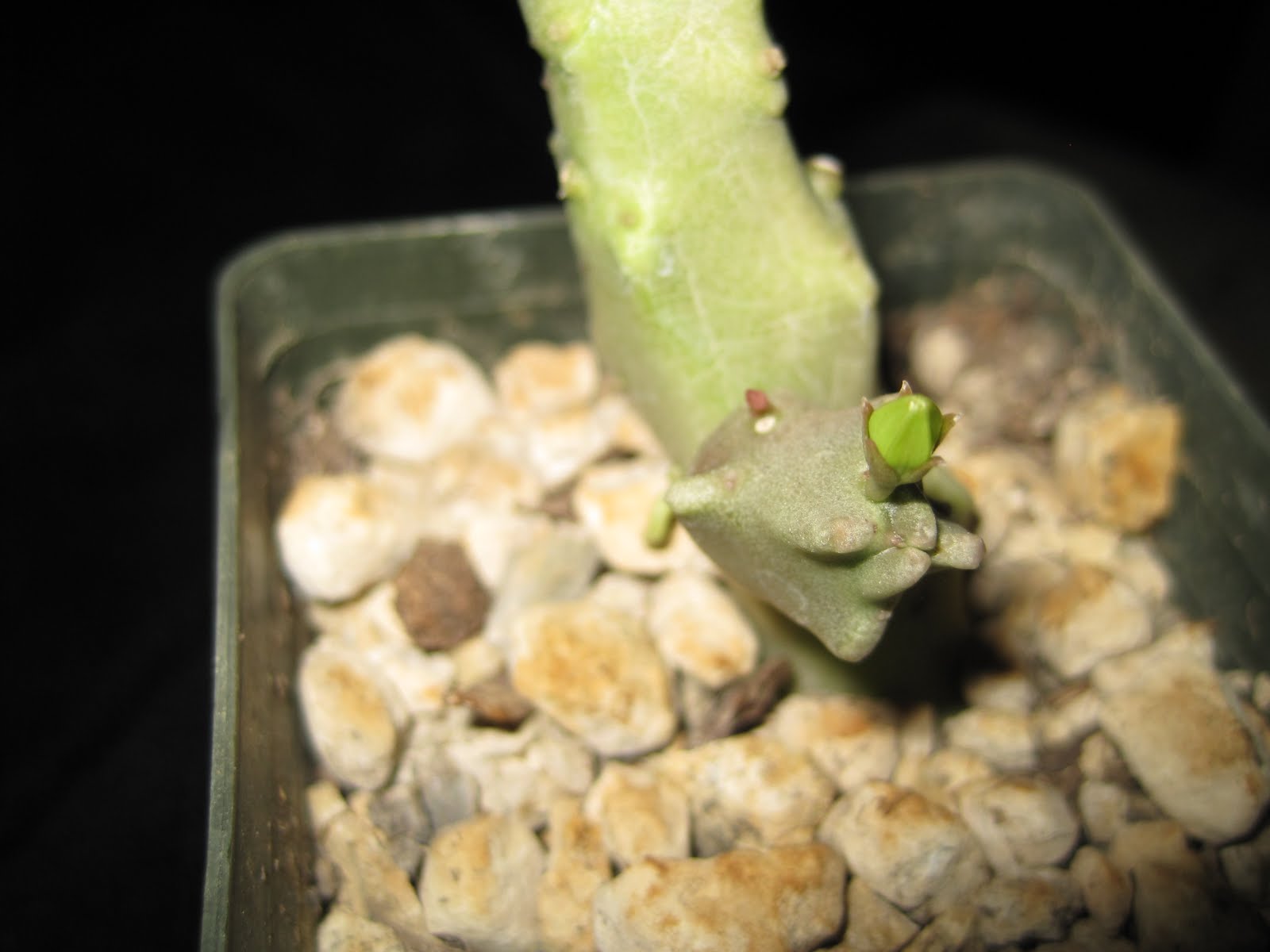
This plant is of the Arid Lands crop that Gethsemane has been selling for the past month.  Bob Webb recommended it to me, so of course I picked it up.  The specimen I picked had two tiny buds on its branching arm, and fortunately, one has been progressing nicely, and hopefully will bloom soon!


You can see the distal bud is starting to take off, but the proximal bud isn't doing too much.  Probably gone already.
Looks like the flower will have five petals...
How about that?  I bet it will open soon. The bud is slower to develop that my Stapelia scitula, which blooms all the time.  Maybe this means the flower will last longer than a week?  Oh, the unbearable anticipation!  I'll post a photo of the flower once it blooms...it is already bigger than this photo this morning!