Search This Blog

Pages

Showing posts with label Cacti and Succulents. Show all posts

Thursday, July 8, 2010

OH, THE DEVASTATION!!!!

Behold, the reason for my infrequent posts!


The dreaded mealybug!! (Gasp! Boo! Hiss!)  Pseudococcidae.  I can think of few other pests that beleaguer indoor gardeners as frequently and as tenaciously as the mealybug...except maybe spider mites.  Maybe it's a tie, and they both lose. 

I had my first experience with mealybugs last year when I took home a beautiful Maranta (prayer plant), and found it to be exploding with white fuzzy stuff within a month.  A more experienced gardener would have probably tossed out the plant, but I have a painful twinge of guilt every time I do that and avoid this as much as possible.  So, I learned the hard way that one can conquer these bugs, rather than acquiesce to the hostile takeover, although it usually involves more trouble than it is worth.   More on how to do this later. 


My prayer plant (Maranta leuconeura var. erythroneura)...its leaves fold up at night when it gets tired, and it looks like it is praying. The backs of the leaves are a pretty maroon.  The leaf tips got a bit crispy this winter, as it was dry in the condo.  I probably should just go ahead and prune it back anyway...

Anyhoo, I purchased a wonderful little Huernia species (labeled Huernia insigniflora, but I think it is probably Huernia confusa) off of e-bay, and unlike any conscientious gardener, of course I did NOT quarantine it.  In fact, like a moron, I noticed several mealybugs on it after I unwrapped the bare root plant, promptly killed them with the time-honored rubbing alcohol on a Q-tip method, AND THEN I STILL PUT IT WITH MY OTHER SUCCULENTS.  Yes, I know.  I deserved what happened next. 

This very little plant belongs to an interesting group of Asclepiadoideae called the Huernias.  Same family as the Stapelias and Duvaliandras, of which I am so fond.   Huernias tend to be short plants with thick, succulent, clumping stems with fleshy tubercles that look like spines.  Not sharp, and with no glochids to hurt you, feel free to cuddle with them as you see fit.  In going with their brothers and sisters, huernias have also evolved to attract flies for pollination, although with slightly smaller and less smelly blooms.  Interestingly, many have a very well developed central ring, or annulus, that has contributed to the common name, "lifesaver plant."

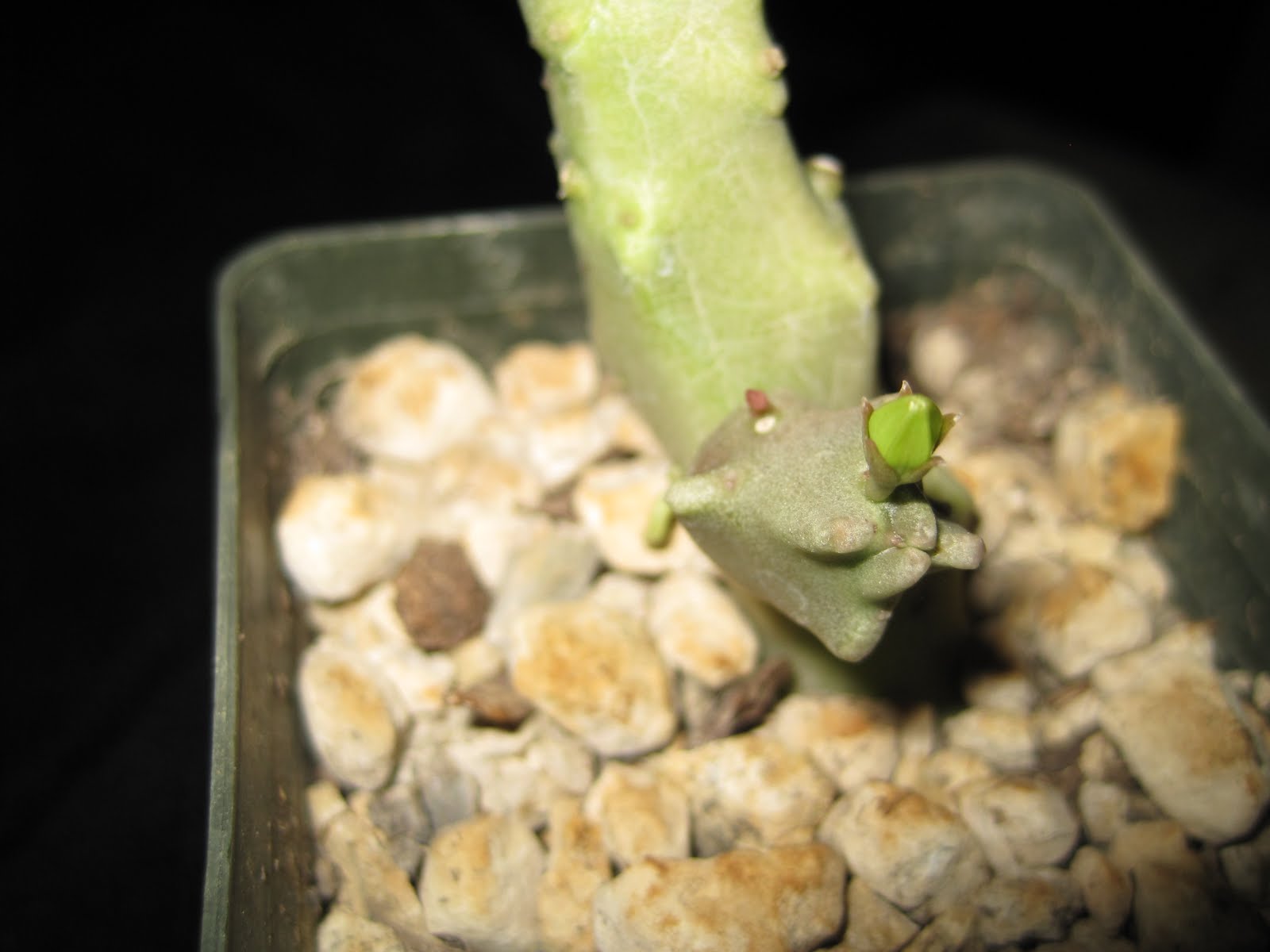
Here is mine:  (MUGSHOT:  MEALYBUG VECTOR AND BRINGER OF PESTILENCE)


Note the tiny bud at right...
This cute little guy started off all fun new growth and promising little flower buds, but soon became the harbinger of doom and broken promises.  Within several weeks, I noticed my poor Stapelia scitula (see previous posts) which had previously been going gangbusters and constantly putting out new blooms seemed to surreptitiously go dormant.  A few tiny mealybabies started showing up on the Huernia, and all flower buds quickly shriveled.  Within days, the Stapelia was consumed within a swarm of soft, fluffy mounds of pediculosis

I have learned that one can do fairly well in eradicating mealybugs with Q-tips dipped in rubbing alcohol.  The alcohol seems to melt away their fluffy, powdery white encasements and shrivels the underlying bug.  You can almost hear the nasty little devils screaming their rage at being sent back to the hell that spawned them.  While immediately gratifying, this method is time consuming as you have to kill every bug and egg casing individually--and the little rascals are very adept at hiding.  Alternatively, Imidacloprid is a nice systemic mealy-killer (I use Bonide).  You just sprinkle it in the dirt, and every time you water, your juicy little succulent becomes a sponge for the toxic chemical, and the mealybugs don't know what hit 'em.  Fortunately, I have found that my succulents have all tolerated the imidacloprid without any apparent side effects.


Behold, Ye Holy hand grenade:


So, as of today, there are no more mealybugs readily visible anywhere, and after several weeks of dormancy the Stapelia scitula is growing and putting out flower buds again.   The future of the Huernia confusa is less certain, however.  For some reason, the buds keep blasting...(bud blast means that a flower bud dies before fully flowering).  I'm tempted to throw it out and look for a new one.  Maybe it only blooms later in the Summer, and has fake-out buds early on....hrrmmm.....stay tuned!

Thursday, May 13, 2010

A stink in time...


The Duvaliandra dioscoridis started opening while we were running around setting up for a champagne "celebrate spring" party.  Oooh, fancy.  I have to admit I was a little worried that people would walk over and try to smell it.  Of course, I did, and....ugh!  Not dirty socks like the Stapelia scitula, this little stinker smells like straight-up poo!  Fortunately, you have to be right up to it to appreciate the aroma.  I smell a prank coming on later tonight....(heehee)
Slowly, but surely, the leaves opened up over the next several hours.   I think it's a pretty nice accomplishment, and I am feeling rather satisfied with my superior indoor gardening abilities.  I really hope I can bloom it again....even better yet, bloom all of these random Stapeliads I've got growing right now.  Maybe I don't have superior indoor gardening abilities, but plants have an incredible adaptive capacity to grow despite being confronted with less-than-ideal circumstances.  Supposedly, these plants grow in the shade of larger plants and stones in the wild, and this was my reasoning behind selecting them for my northern window succulent garden.  Despite accusations to the contrary, I really don't like killing off succulents, but they are so interesting it is impossible not to at least try to grow them.

Here are some more photos of the flower once it completely opened:

Note that an arm is starting to branch out from the main stem!  Cool!

Friday, May 7, 2010

Chicken Little and More Uplifting News...

AACH!  Adenium shock!  Plants Are The Strangest People (blog see link below) opined in a 2008 Wizard of Oz plant analogy thread that the plant best representing the Cowardly Lion is the Adenium obesum.  The reason for this dubious designation is the annoying habit adeniums have of dropping leaves for apparently any reason: a mighty wind...a change in position......a dirty look.  In my case, repotting as well.  I hope this is just shock and not something more sinister like caudex or root rot.  Gross.  Did you know that some of the fungi that rot out your plants can actually kill you?  It's true, although you won't get infected unless your immune system gives out.  So treat yourself right or your roots could rot.


"The sky is falling!  The sky is falling!  No, wait!  That's just my yellow leaves falling to the ground." --Adenium "Chicken little" arabicum seedling

It would look like a sweet 80's-retro, Cyndi Lauper-inspired variegated Mohawk, if this was what was supposed to happen.    Here's hoping for a speedy recovery, Chicken little, and strong new growth over the upcoming growing season. 

In other news...


The Duvaliandra dioscoridis bud is blowing-up faster than last season's "Biggest Loser" contestants.  How big will it get before blooming?  Stay tuned.  It's easily double in size from the last post.  The tips of the petals are becoming slightly salmon colored. 

All is not lost in northern exposure! The unbearable anticipation continues!!


Sunday, May 2, 2010

Spring Growth Update


Duvaliandra dioscoridis.  So, this is in the same group of plants as the Stapelia plants, and I haven't found too much information on it.  I will walk you through all that I know.

Sub-family:  Asclepiadaceae
Genus: Duvaliandra
Species: dioscoridis

Duvaliandra is a monotypic genus consisting of this one species.

D. dioscoridis is endemic to the small Island of Socotra, the largest of an archipelago of four islands in the Indian Ocean, just east of the horn of Africa.  It is part of the Republic of Yemen.  Socotra is so remote that many of the plants on the island are unique to this location, and cannot be found elsewhere in the world.  UNESCO declared Socotra a world heritage site, due to the extraordinary biodiversity.  A rare succulent, indeed.

This plant is of the Arid Lands crop that Gethsemane has been selling for the past month.  Bob Webb recommended it to me, so of course I picked it up.  The specimen I picked had two tiny buds on its branching arm, and fortunately, one has been progressing nicely, and hopefully will bloom soon!


You can see the distal bud is starting to take off, but the proximal bud isn't doing too much.  Probably gone already.
Looks like the flower will have five petals...
How about that?  I bet it will open soon. The bud is slower to develop that my Stapelia scitula, which blooms all the time.  Maybe this means the flower will last longer than a week?  Oh, the unbearable anticipation!  I'll post a photo of the flower once it blooms...it is already bigger than this photo this morning!

Lil' Fatty!


Hello, Adenium!!!

Aren't you the cutest little bonsai'd succulent? 

Aren't you???


If you are asking if this was an impulse purchase from Gethsemane Garden Center last week, the answer is yes.  This little guy was labeled Adenium arabicum seedling and I think was another one of the Arid Lands bounty they have had for a while (its almost gone, so move fast if you still want any).  I'm just going off of the label, I'm not sure how you would be able to distinguish an adenium obesum seedling from an adenium arabicum, but apparently as i read more about it, there is something of a discrepancy going on regarding the nomenclature.  The plant that the lay person such as myself thinks of as adenium arabicum has a very fat caudex with multiple upward reaching branches, with the squat, wide caudex being the main difference separating it from adenium obesum.  So, of course, this is not correct by any means.  Some people think that the arabicum should be correctly labeled as obesum, and that obesum should be labeled something new.  Others feel they are just variants of the same species.  How many licks does it take to get to the tootsie roll center of a tootsie pop?  The world may never know...

So here's the deal with my seedling.  I immediately repotted it from the soggy soil mix it was planted in, gave it a very rocky, sandy, fast draining soil, and stuck it in a pretty little bonsai planter.  I realize if everything goes according to plan, it should outgrow this pot pretty quickly, but there in no guarantee I won't kill it this summer.  Since the adenium are notoriously rot prone, I will probably be taking this little guy straight to work, where it will get direct afternoon sun.  Less chance for rot, and I doubt it would do that well in my north-facing apartment.  Permanent dormancy.  That would be my prediction, anyway.  Suffering the slowest death in the state of Illinois.


What are THESE???
I think they may be new branches, but maybe they are just new leaves...they look like little pink tulips growing out of the seedling's trunk.  Only time will tell...hopefully they just won't involute like the buds on the new Huernia confusa I got in the mail last week...

Let's hope for the best!

Friday, April 23, 2010

STINKY PLANTS

Exciting things are happening in the succulent garden!  Gethsemane Garden Center had its Spring Open House a couple weeks ago (shame on you if you missed it), and much to probably every C+S lover in the greater Chicagoland area, Robert Webb of Arid Lands Greenhouses in Tucson, Arizona was a guest lecturer.  He brought with him a fabulous bunch of rare and exotic succulent plants (of which I bought five members of the Asclepiadoideae subfamily), gave an extemporaneous lecture on some of his favorites, and entertained a Q&A session on both Saturday and Sunday mornings.  Like a huge nerd, I went both days and sat in the second row.  I am not afraid to tell you that I was eyeing a certain Stapelia flavopurpurea with such fierce vengeance I think I would have knocked it out of someones hand had the opportunity presented itself.  Fortunately, restraint and patience prevailed, and  I did not get up in the middle of Dr. Webb's lecture and start snatching up the best of the litter.

Behold!  My Stapelia flavopurpurea in all of its stocky, spotted glory!  To really appreciate what makes this guy special you have to see it in bloom.  Little spindly yellow-red star fish perched upon the tips of each arm giving off a delicate, sweet fragrance.  Stay tuned for pictures of the flowers, but that won't happen until late Summer, early Fall, if at all (given my less than optimal lighting situation).  The blooming habits of this little guy are even more special if you consider that the other members of its family have flowers that smell of rotting meat.  Oh, yes.  It is true and I have PROOF!

So, the subfamily Asclepiadoideae includes some great examples of the creative lengths to which plants have evolved in inhospitable climates.  The subtropical arid climates in which these stinky succulents are endemic lends itself to an abundance of flies, but a paucity of bees and birds to assist in pollination.  Rather than competing for the attention of the latter, the Hoodia, Stapelia, and Huernia spp. have evolved to attract flies to pollinate their flowers!  By creating flowers that stink of death and decay, and even in some cases resembling open wounds and mimicking the textures of rotting, moldy meat, these smelly succulents have the blow fly market cornered!  Outstanding!

This is one of the reasons S. flavopurpurea is so interesting.  A stapeliad that doesn't stink!  Very special.  I sure hope mine blooms eventually or at least gets some new growth on it this summer.


Stapelia scitula, on the other hand, is blooming like crazy.  Well, I won't go that far, but it is covered in buds and has one or two flowers at a time that last about a full week each.  Supposedly this plant blooms throughout the year and sometimes quite impressively.  I personally love plants that bloom frequently.  It can get rather boring waiting for that once a year treat, so having  a few regular bloomers around the house really help to cheer up those drab Chicago winter days.  These guys do stink, but with each bloom the size of  a nickel, you really have to get your nose up into the flower to smell it.  Dirty socks.  Weird. 

This Arid Lands/Gethsemane find (I am embarrassed to say)  may have been purchased before one was technically supposed to do so...(oops).  It was two weeks before the scheduled open house, and after searching online nurseries for a S. scitula, LOW AND BEHOLD Gethsemane gardens has at least half-a-dozen of them!  There may have been a sign over the shelf that said "Not for sale yet," but I didn't realize this until AFTER I had already paid at the desk for it.  Well, karma came my way and part of a small branch got knocked off in transit (see photo from last post), but the plant itself has doubled in size since then and now seems to be as happy as a clam!  Of course I let the stem dry out for a few days before sticking it in some soil.  Maybe it will root!  Mea culpa.

Thursday, April 22, 2010

SPRING AND NEW BEGINNINGS


Spring is here!  Well, actually, it has been here for over a month, but now it has finally blessed my north-facing window garden with floriferous abundance!  This is the first time my paphiopedilum has bloomed since I bought it last summer.  It is a hybrid labeled Incantation x Cocoa Cherry, and was a wine-red lady slipper bloom that lasted quite a while before finally drying up.  Now we wait.  I hope the bud doesn't blast.  That would be disappointing. 

A little background...

I am the proud resident of a north-facing condo in downtown Chicago.  My home possesses beautiful skyline views, lake Michigan peaking out from between towering high-rises, and plenty of light all day long.  Plenty of indirect light.  No direct sun.  Ever. 


Here, in my cave, a genocide has occurred.  Innocent jade plants of all sizes and variegation met a cruel, mushy, fungal demise as a direct result of Sol in absentia.  No sun.                             

Who knew you needed direct sunlight to grow plants???  Well, I sure do now.  After much research, trial, and error, I am now owned by a number of lower-light requiring plants...and more succulents!  Hi, my name is John, and I am a cactus and succulent-a-holic.  I've been a long-time C+S lover, and now I am on a quest to raise a few of my favorites despite my northern exposure.  This blog will chronicle my defeats, lessons, and (hopefully) victories.  However small they may be.  Thrown into the mix will be a collection of vigorous gesneriads, tropical house plants, a couple indestructible plants, and a slightly sunnier office space that I use as a convalescence home for succulents in need.  I have learned that the death of a plant is not a total waste.  While disappointing, we can learn from every failed attempt.  Perhaps most importantly, it provides the opportunity to try again.  Or buy a NEW plant! 

What we call the beginning is often the end.  And to make an end is to make a beginning.  The end is where we start from.  (T. S. Eliot)

Stapelia scitula in bud.