Search This Blog

Pages

Showing posts with label Stapelia. Show all posts

Thursday, July 22, 2010

Back in business!


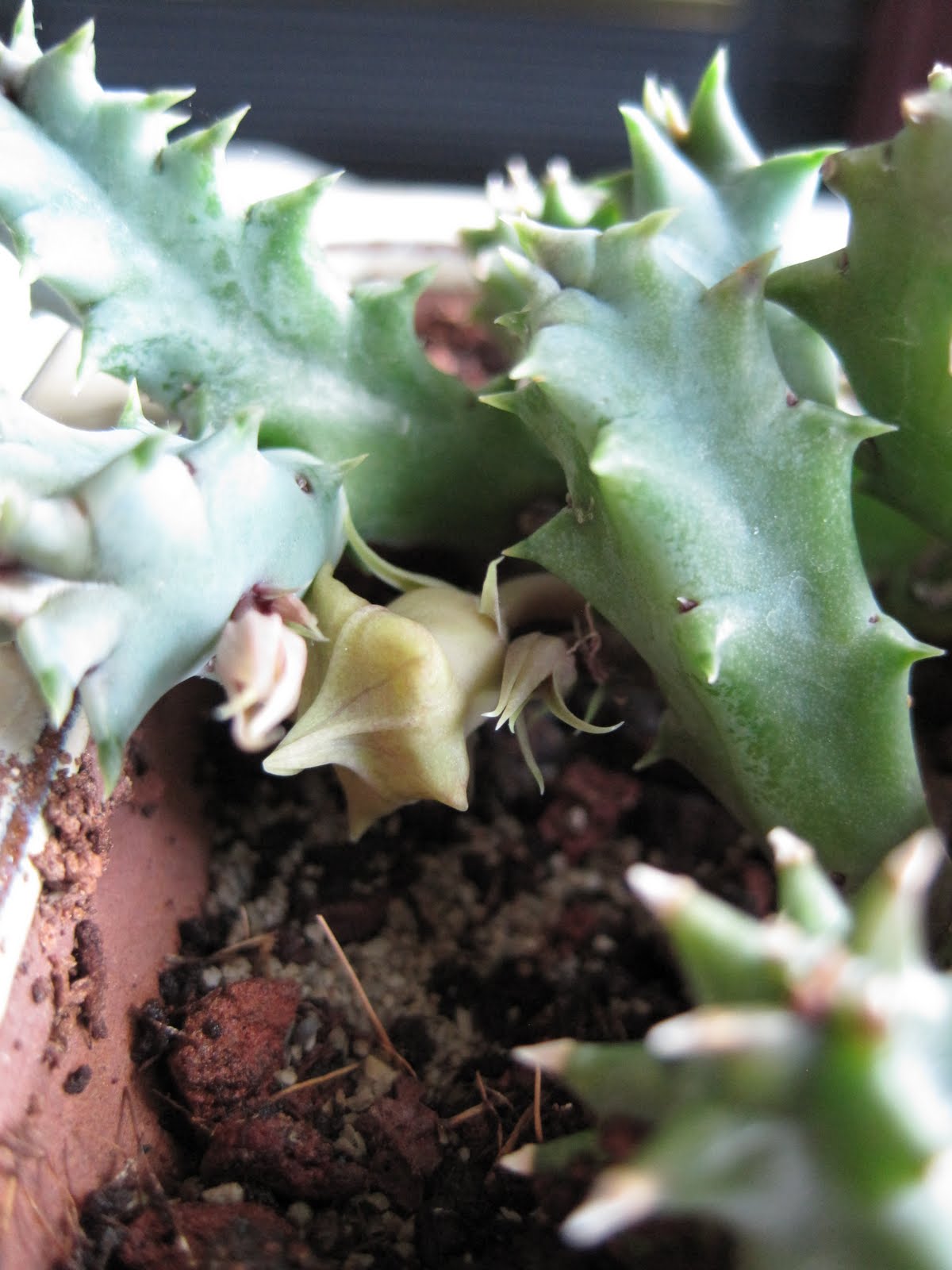
After much consternation and the apocalyptic destruction at the hands of Bonide and rubbing alcohol,  BAM!  We are blooming and putting out new growth again!  Here's the Stapelia scitula covered in buds and much bigger than ever.

Mealy-what???

Perhaps even more exciting, (...I know, I know, you can't bear the anticipation.....)
TAH-DAH!!


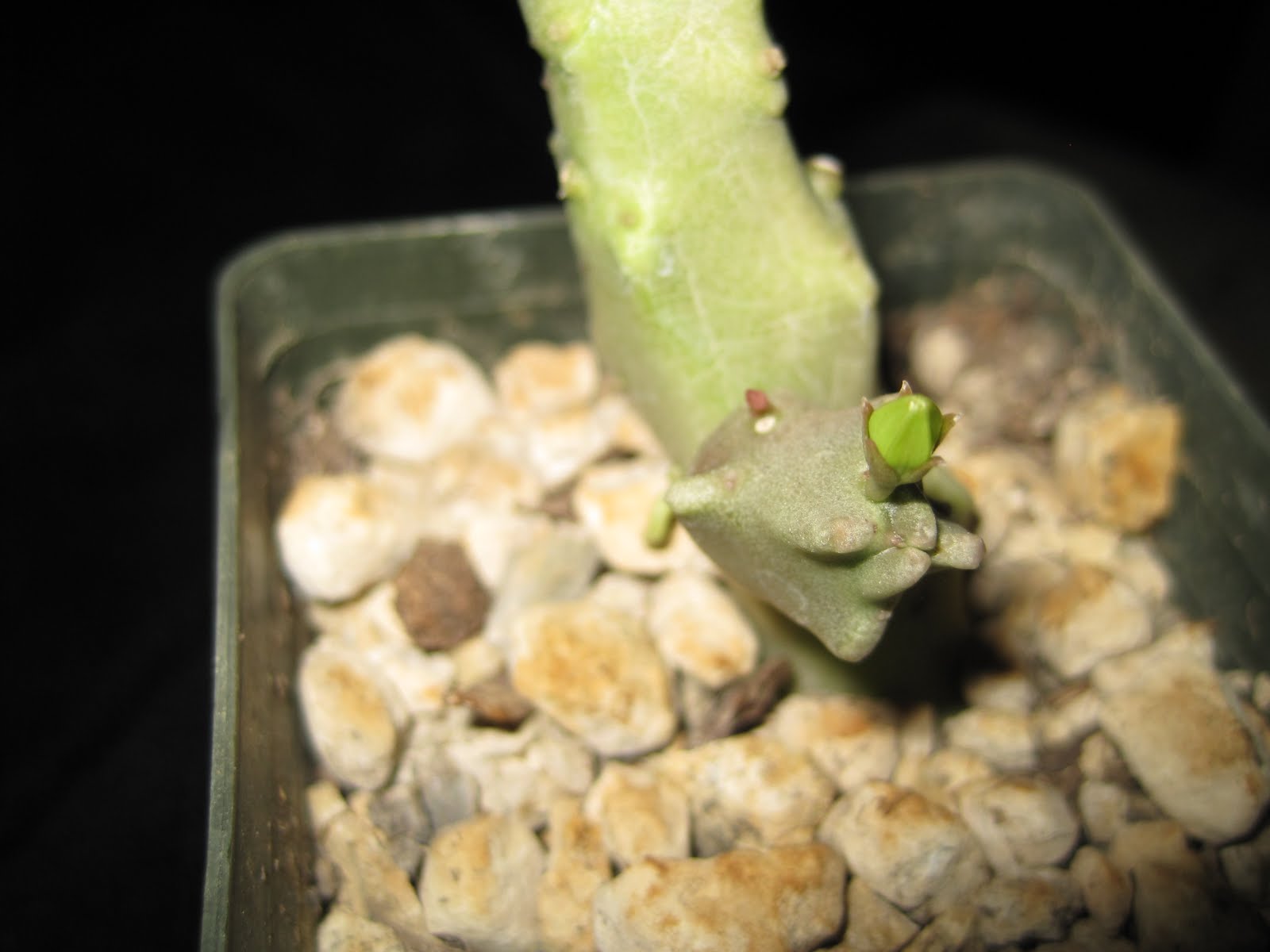
YESSSSSSS! Finally, the Huernia confusa (I think, we will see when she blooms) is putting out viable flower buds!!  I also figured out what I was doing wrong--I was underwatering.  WHOA!  Actually, underwatering a succulent is a hard thing to achieve, especially in the absence of direct sunlight, but stapeliads apparently need a fair amount of water during their growing season.  This bud is going to make it!  I promise to post the flower.  Despite excruciating de-bugging and Bonide to the soil, it continues to breed mealybugs.  Freakin' Typhoid Mary.  I hope they aren't imidacloprid-resistant bugs, or who knows what may happen.  I caught a few mealies on my Streps....let's just say I was NOT amused.  I gave them a little medicine, too.  Bonide for everybody!!!

Thursday, May 13, 2010

A stink in time...


The Duvaliandra dioscoridis started opening while we were running around setting up for a champagne "celebrate spring" party.  Oooh, fancy.  I have to admit I was a little worried that people would walk over and try to smell it.  Of course, I did, and....ugh!  Not dirty socks like the Stapelia scitula, this little stinker smells like straight-up poo!  Fortunately, you have to be right up to it to appreciate the aroma.  I smell a prank coming on later tonight....(heehee)
Slowly, but surely, the leaves opened up over the next several hours.   I think it's a pretty nice accomplishment, and I am feeling rather satisfied with my superior indoor gardening abilities.  I really hope I can bloom it again....even better yet, bloom all of these random Stapeliads I've got growing right now.  Maybe I don't have superior indoor gardening abilities, but plants have an incredible adaptive capacity to grow despite being confronted with less-than-ideal circumstances.  Supposedly, these plants grow in the shade of larger plants and stones in the wild, and this was my reasoning behind selecting them for my northern window succulent garden.  Despite accusations to the contrary, I really don't like killing off succulents, but they are so interesting it is impossible not to at least try to grow them.

Here are some more photos of the flower once it completely opened:

Note that an arm is starting to branch out from the main stem!  Cool!

Monday, May 10, 2010

FEED ME SEYMOUR, FEED ME NOW!!!

"Must be blood."
"Two-ey, that's gross!"
"Must be fresh."
"I don't wanna hear this."
"Feed me, Seymour, feed me all night looong!"

The Little Shop of Horrors is here at last!  The Duvaliandra bud is beginning to open!  It has been almost a month since the bud formed, and now the flower is going to be bigger than the branch!   Whoa! 

The petals are opening up like a mouth, and I can't help but think of Audrey II from the Little Shop of Horrors.  If it starts singing, I won't fall for its empty promises.  I stayed awake through the second act of that Broadway play.  Don't feed the plants!
Poor Audrey.

Stay tuned for more pics!  I know you wish you were here for the blooming of this rare and endangered succulent plant, but I promise plenty of photos.

Sunday, May 2, 2010

Spring Growth Update


Duvaliandra dioscoridis.  So, this is in the same group of plants as the Stapelia plants, and I haven't found too much information on it.  I will walk you through all that I know.

Sub-family:  Asclepiadaceae
Genus: Duvaliandra
Species: dioscoridis

Duvaliandra is a monotypic genus consisting of this one species.

D. dioscoridis is endemic to the small Island of Socotra, the largest of an archipelago of four islands in the Indian Ocean, just east of the horn of Africa.  It is part of the Republic of Yemen.  Socotra is so remote that many of the plants on the island are unique to this location, and cannot be found elsewhere in the world.  UNESCO declared Socotra a world heritage site, due to the extraordinary biodiversity.  A rare succulent, indeed.

This plant is of the Arid Lands crop that Gethsemane has been selling for the past month.  Bob Webb recommended it to me, so of course I picked it up.  The specimen I picked had two tiny buds on its branching arm, and fortunately, one has been progressing nicely, and hopefully will bloom soon!


You can see the distal bud is starting to take off, but the proximal bud isn't doing too much.  Probably gone already.
Looks like the flower will have five petals...
How about that?  I bet it will open soon. The bud is slower to develop that my Stapelia scitula, which blooms all the time.  Maybe this means the flower will last longer than a week?  Oh, the unbearable anticipation!  I'll post a photo of the flower once it blooms...it is already bigger than this photo this morning!

Friday, April 23, 2010

STINKY PLANTS

Exciting things are happening in the succulent garden!  Gethsemane Garden Center had its Spring Open House a couple weeks ago (shame on you if you missed it), and much to probably every C+S lover in the greater Chicagoland area, Robert Webb of Arid Lands Greenhouses in Tucson, Arizona was a guest lecturer.  He brought with him a fabulous bunch of rare and exotic succulent plants (of which I bought five members of the Asclepiadoideae subfamily), gave an extemporaneous lecture on some of his favorites, and entertained a Q&A session on both Saturday and Sunday mornings.  Like a huge nerd, I went both days and sat in the second row.  I am not afraid to tell you that I was eyeing a certain Stapelia flavopurpurea with such fierce vengeance I think I would have knocked it out of someones hand had the opportunity presented itself.  Fortunately, restraint and patience prevailed, and  I did not get up in the middle of Dr. Webb's lecture and start snatching up the best of the litter.

Behold!  My Stapelia flavopurpurea in all of its stocky, spotted glory!  To really appreciate what makes this guy special you have to see it in bloom.  Little spindly yellow-red star fish perched upon the tips of each arm giving off a delicate, sweet fragrance.  Stay tuned for pictures of the flowers, but that won't happen until late Summer, early Fall, if at all (given my less than optimal lighting situation).  The blooming habits of this little guy are even more special if you consider that the other members of its family have flowers that smell of rotting meat.  Oh, yes.  It is true and I have PROOF!

So, the subfamily Asclepiadoideae includes some great examples of the creative lengths to which plants have evolved in inhospitable climates.  The subtropical arid climates in which these stinky succulents are endemic lends itself to an abundance of flies, but a paucity of bees and birds to assist in pollination.  Rather than competing for the attention of the latter, the Hoodia, Stapelia, and Huernia spp. have evolved to attract flies to pollinate their flowers!  By creating flowers that stink of death and decay, and even in some cases resembling open wounds and mimicking the textures of rotting, moldy meat, these smelly succulents have the blow fly market cornered!  Outstanding!

This is one of the reasons S. flavopurpurea is so interesting.  A stapeliad that doesn't stink!  Very special.  I sure hope mine blooms eventually or at least gets some new growth on it this summer.


Stapelia scitula, on the other hand, is blooming like crazy.  Well, I won't go that far, but it is covered in buds and has one or two flowers at a time that last about a full week each.  Supposedly this plant blooms throughout the year and sometimes quite impressively.  I personally love plants that bloom frequently.  It can get rather boring waiting for that once a year treat, so having  a few regular bloomers around the house really help to cheer up those drab Chicago winter days.  These guys do stink, but with each bloom the size of  a nickel, you really have to get your nose up into the flower to smell it.  Dirty socks.  Weird. 

This Arid Lands/Gethsemane find (I am embarrassed to say)  may have been purchased before one was technically supposed to do so...(oops).  It was two weeks before the scheduled open house, and after searching online nurseries for a S. scitula, LOW AND BEHOLD Gethsemane gardens has at least half-a-dozen of them!  There may have been a sign over the shelf that said "Not for sale yet," but I didn't realize this until AFTER I had already paid at the desk for it.  Well, karma came my way and part of a small branch got knocked off in transit (see photo from last post), but the plant itself has doubled in size since then and now seems to be as happy as a clam!  Of course I let the stem dry out for a few days before sticking it in some soil.  Maybe it will root!  Mea culpa.

Thursday, April 22, 2010

SPRING AND NEW BEGINNINGS


Spring is here!  Well, actually, it has been here for over a month, but now it has finally blessed my north-facing window garden with floriferous abundance!  This is the first time my paphiopedilum has bloomed since I bought it last summer.  It is a hybrid labeled Incantation x Cocoa Cherry, and was a wine-red lady slipper bloom that lasted quite a while before finally drying up.  Now we wait.  I hope the bud doesn't blast.  That would be disappointing. 

A little background...

I am the proud resident of a north-facing condo in downtown Chicago.  My home possesses beautiful skyline views, lake Michigan peaking out from between towering high-rises, and plenty of light all day long.  Plenty of indirect light.  No direct sun.  Ever. 


Here, in my cave, a genocide has occurred.  Innocent jade plants of all sizes and variegation met a cruel, mushy, fungal demise as a direct result of Sol in absentia.  No sun.                             

Who knew you needed direct sunlight to grow plants???  Well, I sure do now.  After much research, trial, and error, I am now owned by a number of lower-light requiring plants...and more succulents!  Hi, my name is John, and I am a cactus and succulent-a-holic.  I've been a long-time C+S lover, and now I am on a quest to raise a few of my favorites despite my northern exposure.  This blog will chronicle my defeats, lessons, and (hopefully) victories.  However small they may be.  Thrown into the mix will be a collection of vigorous gesneriads, tropical house plants, a couple indestructible plants, and a slightly sunnier office space that I use as a convalescence home for succulents in need.  I have learned that the death of a plant is not a total waste.  While disappointing, we can learn from every failed attempt.  Perhaps most importantly, it provides the opportunity to try again.  Or buy a NEW plant! 

What we call the beginning is often the end.  And to make an end is to make a beginning.  The end is where we start from.  (T. S. Eliot)

Stapelia scitula in bud.